Data & Process Orchestration: One consistent version of the business.
Connect finance, network, product, and operational systems into a governed data foundation — with shared rules, reconciled definitions, and a traceable path from source to output.
Role in the platform
Governed data foundation
Connects to
Outputs
6 representative output types
The data exists. The agreement doesn't.
Critical decisions depend on data held across finance, network, OSS/BSS, and commercial systems. When definitions, mappings, and calculation rules differ between departments, the same business question can produce several different answers.
Fragmented view
Current stateOne question. Four answers.
Definitions drift
The same customer, site, or cost category means something different in each system.
Reconciliation is manual
Teams spend time explaining why reports disagree instead of acting on them.
Lineage stops at the report
When a rule changes, no one can confidently say which models or outputs were affected.
The shift
A governed data foundation with shared definitions, reconciled results, and lineage that survives change.
Capabilities that connect analysis to evidence.
Each capability contributes a defined part of the analytical chain — and remains inspectable by the teams who rely on it.
Multi-source integration
Connect structured data from finance and GL, network inventory, OSS/BSS, service, product, customer, and reference systems.
Shared business rules
Centralise definitions, mappings, and calculation logic so every team works from the same agreed standard.
Single source of truth
Establish governed, reconciled datasets as the reference point for downstream costing, profitability, and reporting.
End-to-end traceability
Track inputs, transformations, rules, dependencies, and outputs across every step of the analytical chain.
Validation & reconciliation
Apply data-quality controls and reconcile results against finance and operational reference sources.
Change impact visibility
Understand which outputs, models, and reports are affected when a source, rule, or assumption changes.
See the analytical chain, not just the output.
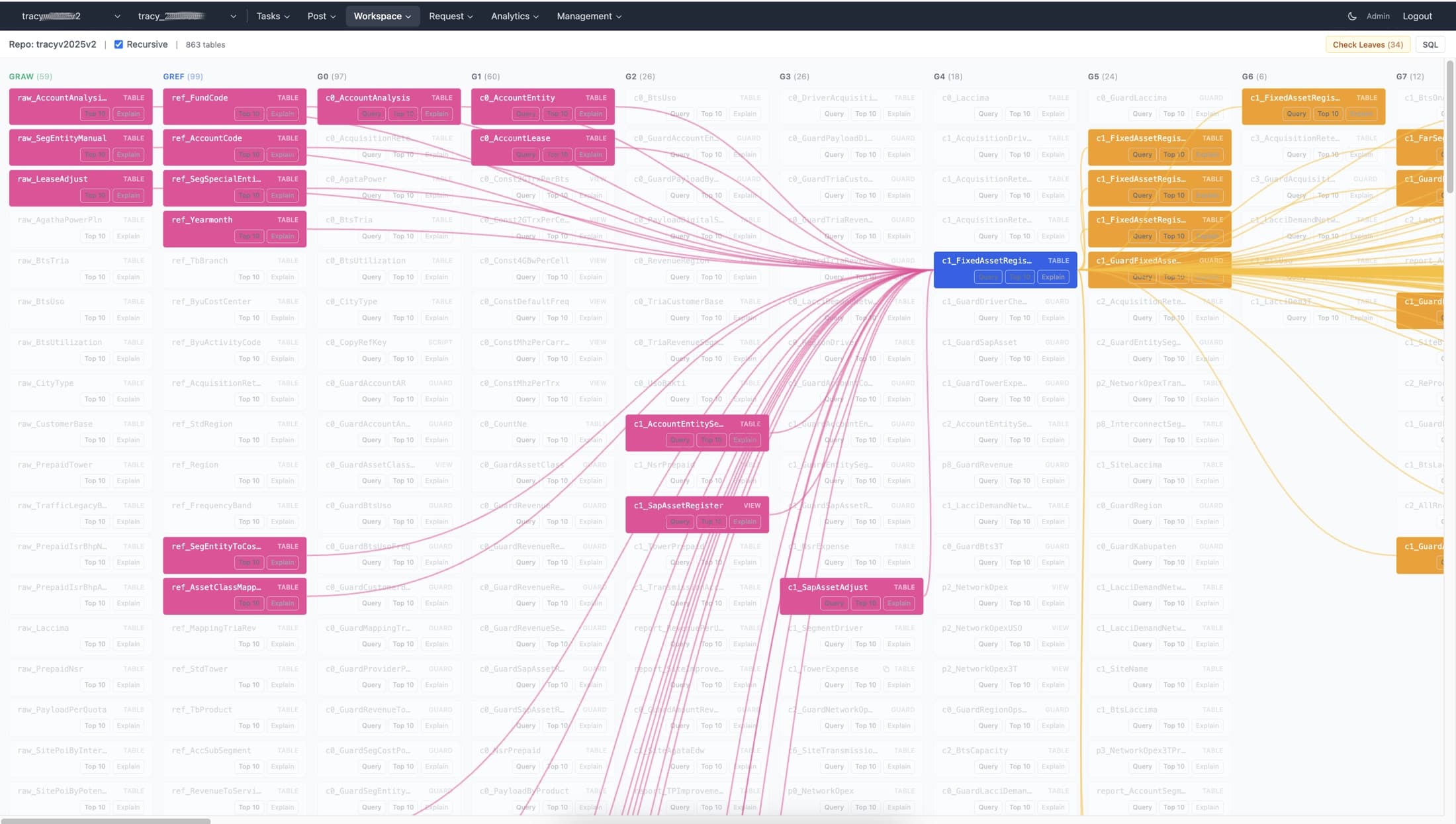
The orchestration layer is visible by design. Follow a result back through the tables, rules, and documentation that produced it — or ask the analytical assistant to explain it.
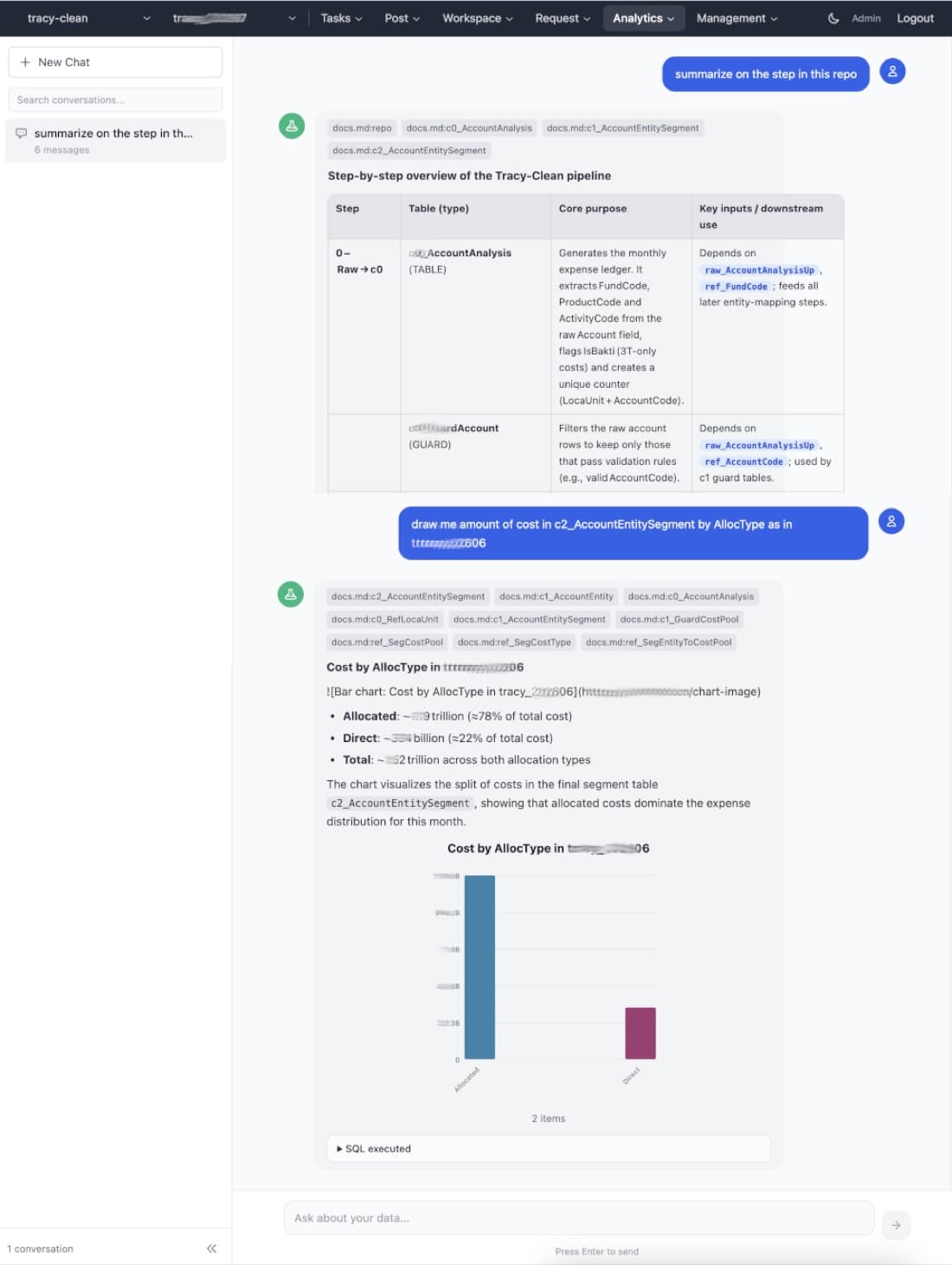
Traceable answers
Assistant responses cite the tables, documentation, and calculation steps behind the result.
Lineage by repository
Table-level dependencies map raw inputs through guard, segment, and reference layers.
One analytical workspace
Analysis, explanation, and execution evidence live in the same environment.
How to read this view
The lineage graph and the assistant answer are two views of the same governed chain. The graph shows structural dependencies; the assistant explains a specific result and cites the records and rules behind it.
Same chain, different lens
Both views are generated from the same governed data and calculation model. That is what keeps the explanation consistent with the number.
A repeatable analytical sequence.
The sequence keeps methodology consistent while allowing the model to reflect the client's operating reality.
Ingest
Map and connect source systems with clear ownership and data contracts.
Standardise
Align definitions, dimensions, and structures across organisational boundaries.
Orchestrate
Sequence transformations, business rules, and validation into repeatable processes.
Trace
Record lineage, dependencies, and execution evidence for every output.
What the work can produce.
Specific deliverables, depth, and visualisation are agreed according to engagement scope and available source data.
Capability and output descriptions are illustrative. Client-specific results and deployment status are added only when verified and approved for publication.
This engine is one part of a larger chain.
Explore the engines it works with, or see how the platform turns their combined output into decisions.
Put orchestration to work on a real question.
We can explore the capability against your current data, systems, and decision requirements — without assuming a predetermined scope.